Offside Rule In Football Explained, With The VAR Lines That Judge It
Law 11 is three tests, not one, and most arguments are about the second. The rule as written, the exceptions, how semi automated technology draws the line, and what is only being trialled.
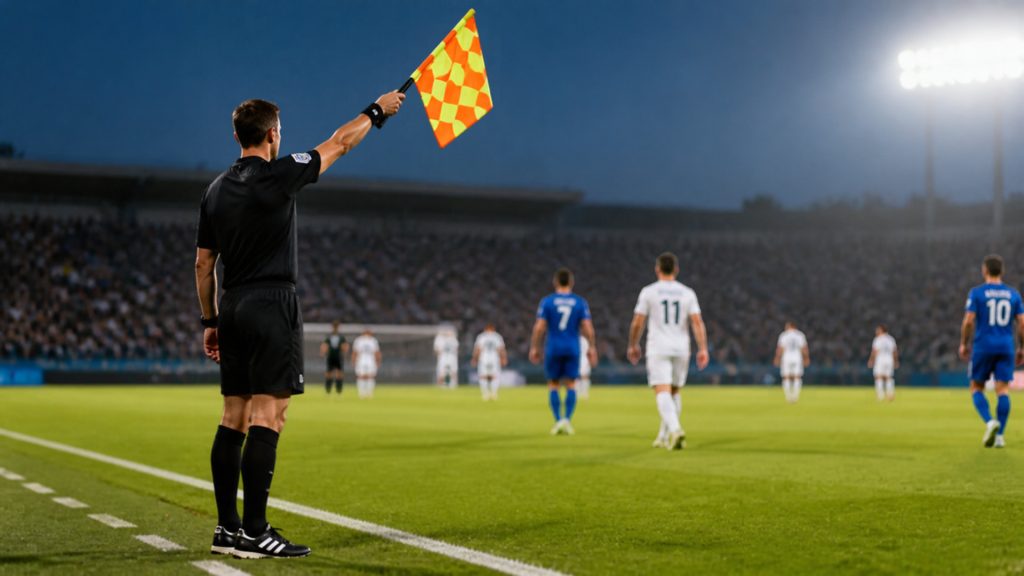
More arguments in football start with the offside flag than with anything else in the laws, and most of them are not really about the law at all. They are about one clause inside it. Law 11 has three separate tests, and a player can fail the first one all afternoon without committing a single offence.
This is the rule as it is written for the 2026/27 season, the way the technology applies it, and the part that is still only being trialled.
Law 11 In One Sentence
A player is penalised for offside if, at the moment a team-mate plays the ball, they are in an offside position and then become involved in active play. Position alone is not an offence. Involvement from an onside position is not an offence either. It takes both, at the same moment.
The Three Tests
One: Offside Position
A player is in an offside position if any part of the head, body or feet is in the opponents’ half and nearer to the opponents’ goal line than both the ball and the second-last opponent. Arms and hands do not count, and the arm is measured down to the bottom of the armpit, because you cannot score with them.
Two details catch people out. The second-last opponent is usually the last outfield defender, with the goalkeeper as the last, but not always: if the keeper has come forward, the second-last opponent might be two defenders. And level is onside. A player level with the second-last opponent, or level with the last two opponents, is not in an offside position at all.
Two: Involvement In Active Play
This is where the arguments live. A player in an offside position is only penalised if they then do one of three things.
- Interfere with play. Touch or play a ball passed or touched by a team-mate.
- Interfere with an opponent. Block the line of vision, challenge for the ball, make an obvious action that affects an opponent’s ability to play it, or make a movement that clearly deceives or distracts.
- Gain an advantage. Play a ball that rebounds off the post, the crossbar, a match official or an opponent, having been in an offside position when it was played.
Three: The Moment The Ball Is Played
Everything freezes at the instant the ball is played or touched by a team-mate, not when it arrives. A striker who times a run to be level at the pass and is five metres clear when the ball lands has done nothing wrong. This is the single most common misreading of the law in a living room.
When Offside Does Not Apply At All
| Situation | Can a player be offside? |
|---|---|
| Receiving directly from a goal kick | No |
| Receiving directly from a throw-in | No |
| Receiving directly from a corner kick | No |
| Standing in their own half when the ball is played | No |
| Level with the second-last opponent | No |
| Receiving from an opponent’s deliberate play, other than a save | No |
The last line is the clarification that settled years of argument. If a defender deliberately plays the ball, and it is not an attempt to save, the attacker is treated as having received it fresh and is not penalised. A deflection off a defender who was simply hit by the ball is not deliberate play, and the offside stands. A deliberate save by anybody, keeper or not, also leaves the offside in place.
The Punishment
An offside offence is an indirect free kick to the defending side, taken from the place where the offence happened, including inside the attacking side’s own half. It is not a card. There is no such thing as a deliberate offside offence in the disciplinary sense.
How The Lines Are Drawn
Semi-automated offside technology uses a dense set of cameras to track the limbs of every player and the ball many times a second, works out the exact frame at which the ball was played, and generates the offside line from the tracking data rather than from an operator dragging a line across a freeze frame. The decision is still signed off by a human in the video room, which is what the word semi is doing in the name.
The advantage is speed and consistency. The cost is the toenail offside, where a margin invisible to everybody in the ground decides a goal, because the law is written as a binary and the technology now measures it like one. That tension is the reason the law is being looked at.
The Daylight Trial
Arsene Wenger, FIFA’s chief of global football development, has pushed for years for a version in which an attacker is only offside when there is clear daylight between them and the defender. In effect the attacker would have to be entirely beyond the second-last opponent to be penalised, which hands a large advantage to attacking teams.
European administrators did not support it. Instead, in cooperation with FIFA, the Canadian Premier League began trialling the daylight interpretation at professional level from the start of its 2026 season on 4 April. A compromise has also been aired, judging a player offside only when the torso is beyond the defender, and youth trials of that version are being prepared. None of this is the law anywhere else yet, and it is worth saying plainly: if you watched a top-flight match this season, the strict version applied.
What Actually Changed For 2026/27
The offside law itself did not change. Several things around it did, approved at the IFAB annual general meeting in February 2026, applied at the 2026 World Cup and written into the Laws of the Game from 1 July 2026.
- Video review was extended to clearly incorrect corner awards and to second yellow card decisions.
- The countdown principle that already applied to goalkeepers holding the ball was extended to throw-ins and goal kicks.
- A countdown now applies to substitutions, with players required to leave the pitch promptly.
- Senior international friendlies may use eight substitutes, and up to eleven by agreement.
Three Things People Still Get Wrong
You Cannot Be Offside From A Pass Backwards
You can. The law says nothing about the direction of the pass. It only asks where you were relative to the ball and the second-last opponent at the moment it was played. A player ahead of the ball who receives a square pass can be offside.
The Keeper Is Always The Last Defender
Only usually. The law counts opponents, not positions. If the goalkeeper is up for a corner, the second-last opponent is an outfield player, and the offside line sits wherever that player is standing.
Being Offside And Not Touching The Ball Is Safe
Not if you were in the goalkeeper’s line of vision, or challenged for it, or made a movement that clearly affected an opponent. Interfering with an opponent does not require contact with the ball at all.
If you like rules that quietly decide results, two more in the same family: how Formula 1 scores a championship and how cricket rewrites a target in the rain.
How This Page Is Kept
Figures and clauses on this page were checked against the governing body’s published rules on the date shown above. When a law or a record changes we update the page and move that date. Corrections go to [email protected] and are dealt with first.